
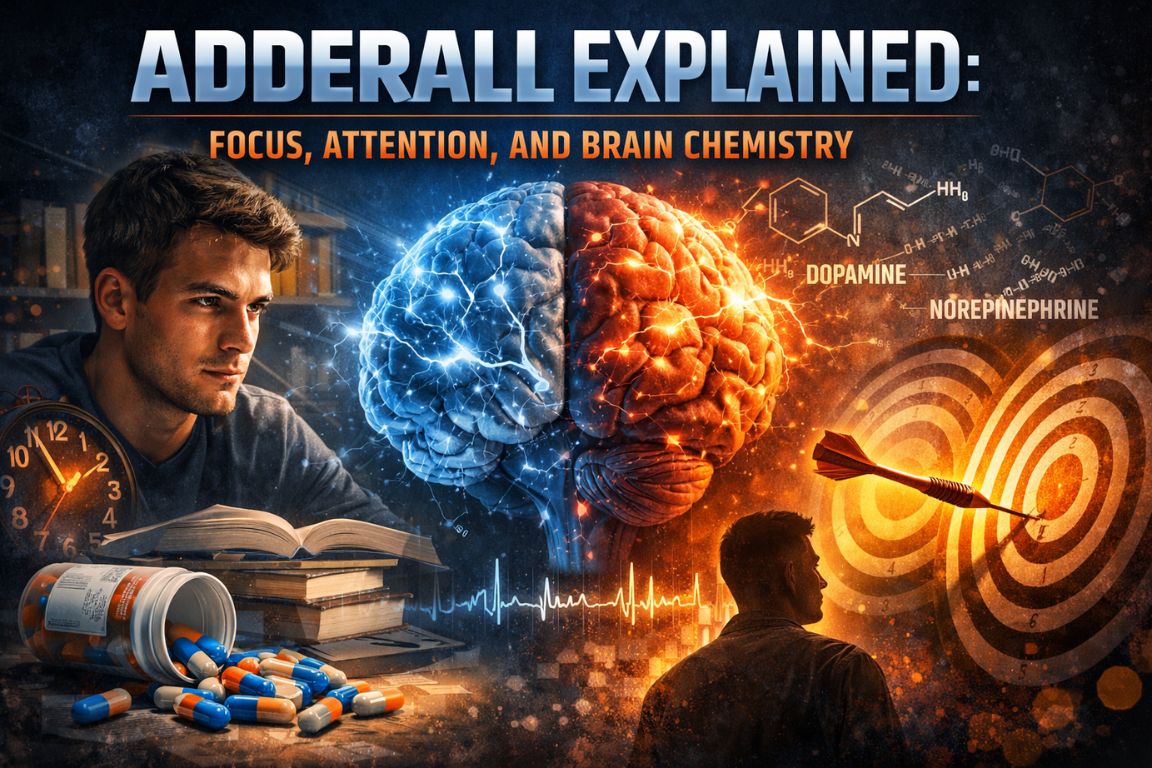
Adderall is a prescription medication commonly discussed in relation to focus, attention, and cognitive performance. While it’s widely known, it’s often misunderstood. Understanding how Adderall works—and why it’s prescribed—helps clarify its role in modern mental health care.
What Is Adderall?
Adderall is a prescription medication that contains a combination of amphetamine salts. It is most commonly prescribed for attention-deficit/hyperactivity disorder (ADHD) and, in some cases, narcolepsy.
It is classified as a central nervous system stimulant and is intended to be used under medical supervision.
How Adderall Works
Adderall affects brain chemistry by increasing the activity of certain neurotransmitters, primarily dopamine and norepinephrine. These chemicals play key roles in attention, motivation, and impulse control.
By influencing these pathways, Adderall may help:
- Improve sustained attention
- Support focus and task completion
- Reduce impulsivity in individuals with ADHD
It does not create focus on its own—it helps regulate systems that are already involved in attention and control.
What Adderall Does Not Do
Adderall does not:
- Automatically improve intelligence or creativity
- Replace healthy routines or behavioral strategies
- Work the same way for everyone
- Serve as a general productivity solution
Its effects depend on individual brain chemistry and medical need.
Why Adderall Is Prescribed Carefully
Because Adderall is a stimulant, healthcare providers prescribe it with care. Medical oversight helps ensure:
- Appropriate diagnosis
- Correct dosing
- Monitoring for side effects
- Safe, responsible use
It is typically one component of a broader treatment plan that may include behavioral strategies or therapy.
The Takeaway
Adderall plays a specific role in supporting attention and focus for individuals it’s prescribed for. When used responsibly and under medical guidance, it can be an effective part of managing attention-related conditions.
Understanding what it does—and what it doesn’t—helps promote informed, realistic expectations.
Canada’s #1 Rx Online Shop
🛒 Buy Now
💸 20% off the entire store — no minimum
Promo Code: BLOG20